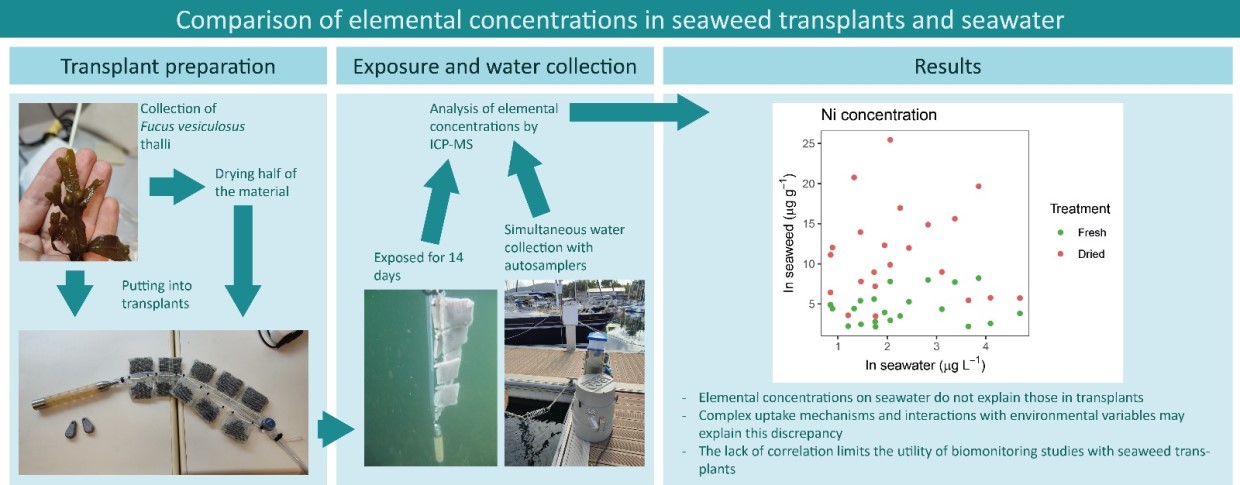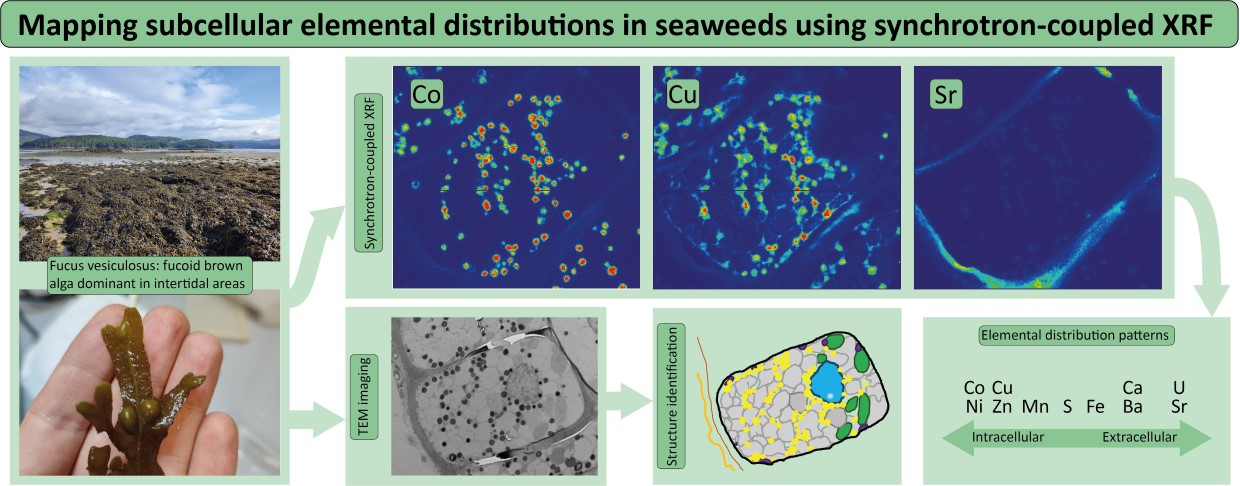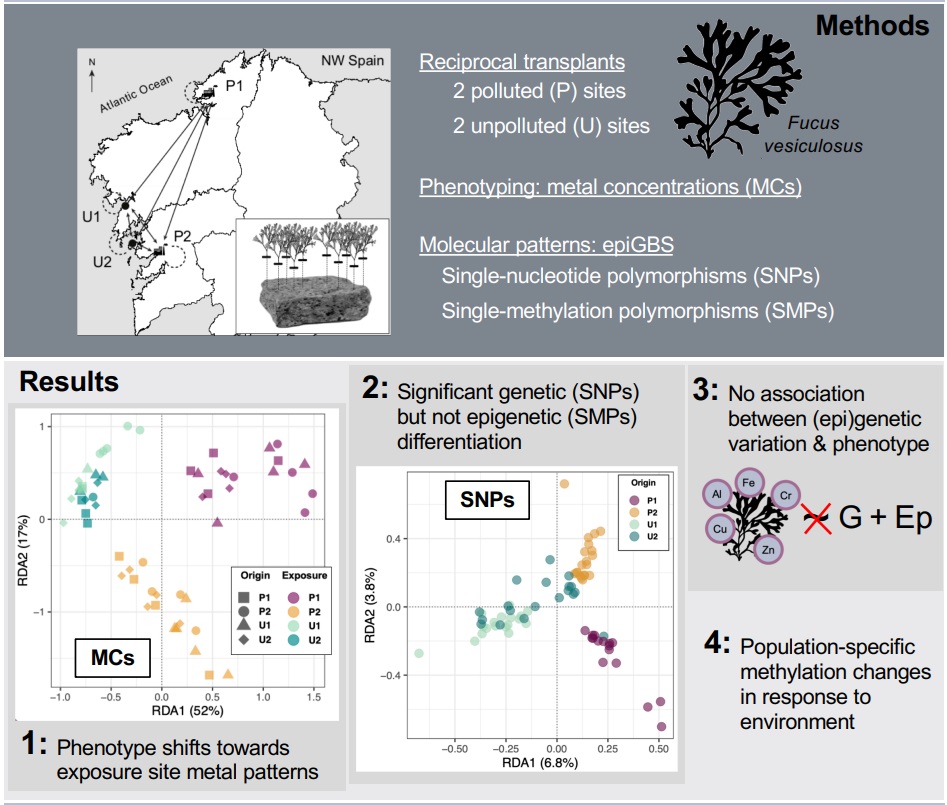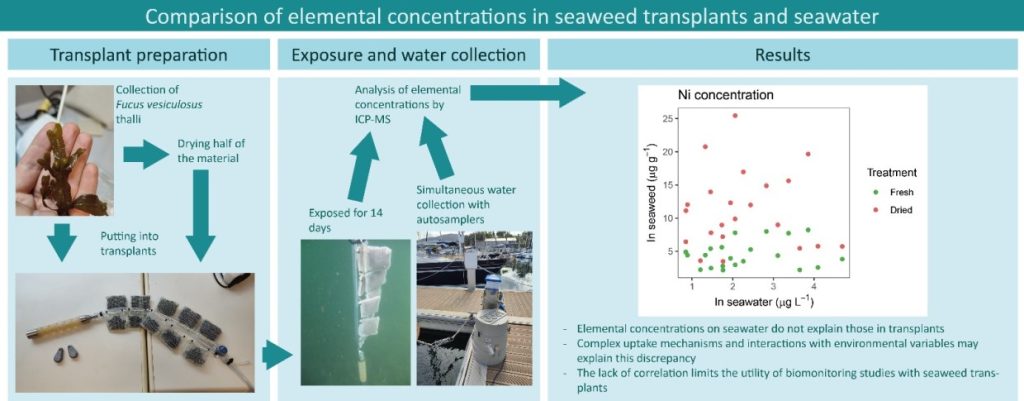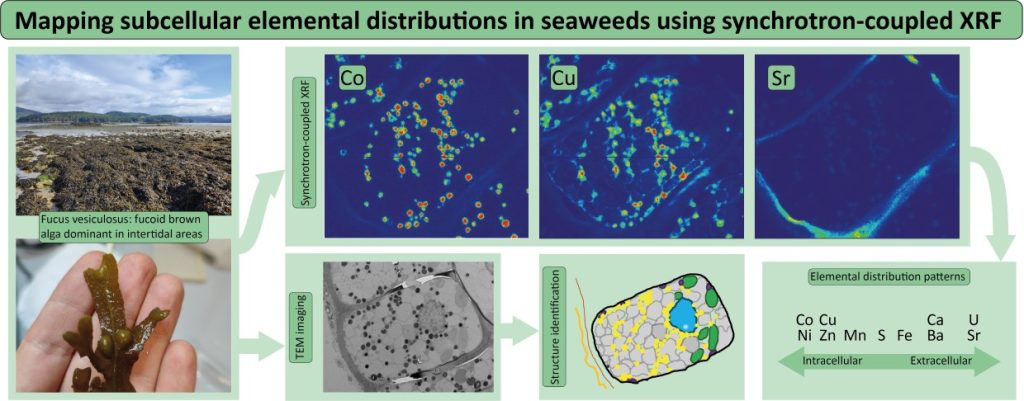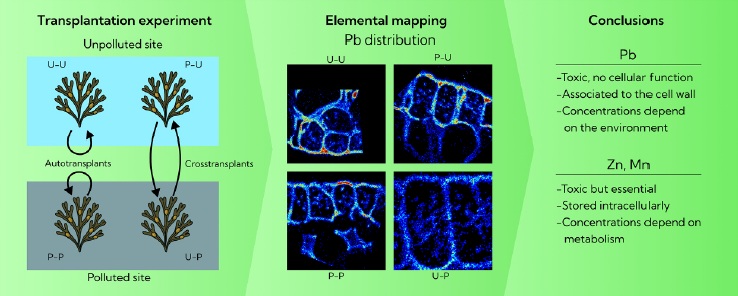
Pollution by potentially toxic elements (PTEs) such as Pb and Zn threatens seaweed populations, which sustain marine coastal ecosystems. Understanding how seaweeds uptake and release these pollutants is crucial to assessing their impact. To address this, we analyzed the subcellular location of PTEs in transplanted thalli of the brown seaweed Fucus vesiculosus using nanoscale secondary ion mass spectrometry (NanoSIMS). Lead accumulated primarily in the cell wall, with minimal intracellular localization. Its concentrations increased slightly upon exposure at a polluted site and decreased at an unpolluted site, reflecting an equilibrium between environmental bioavailability and cell wall binding sites. In contrast, metabolically important PTEs such as Mn and Zn exhibited higher intracellular concentrations that responded similarly when transplanted to a different site regardless of its pollution levels, likely as a stress response to changes in environmental conditions. PTEs without metabolic functions, such as Pb, are not internalized and remain in equilibrium with the environment, whereas intracellular essential PTEs are metabolically regulated. This contrast explains why PTEs differ in toxicity to seaweeds, advancing our understanding of their vulnerability to pollution and enabling more effective strategies to protect the ecosystems they support.
Authors:
Vázquez-Arias, A., Rodríguez-Prieto, C., Yamada, Y., Ito, M., Fernández, J.A., Aboal, J.R.
Other project progress.
Authors:
Vázquez-Arias, A., Boquete M.T., Fernández, J.A., Aboal, J.R.
Authors:
Vázquez-Arias, A., Boquete, M.T., Martín-Jouve, B., Tucoulou, R., Rodríguez-Prieto, C., Fernández, J.A., Aboal, J.R.
Authors:
García Seoane, R., Richards, C.L., Aboal, J.R., Fernández, J.A., Schmid, M.W., Boquete, M.T.
Paper:
Journal of Hazardous Materials 480 (2024) 136304